Will the Bankruptcy of Oi in Brazil Have an Effect on U.S. Markets?

On June 10, 2016, former Oi CEO Bayard Gontijo resigned from the company after it was obvious that his attempts to negotiate a new debt settlement with shareholders was about to fall apart. Oi SA is the fourth largest mobile telecom company in Brazil, and it is the only telecom company in the country partially funded by the government.

In 2010, Oi signed an agreement with the Brazilian government to expand the country’s archaic and failing landline system to rural customers. After years of sinking millions of dollars into that expansion and the effect of other economic factors, the company finally had to admit that it was in trouble and filed for bankruptcy in Brazil on June 20, 2016. At $19.3 billion dollars, the Oi bankruptcy is the largest in Brazil’s history.

What Happened?

Over the past several years, Oi has suffered from poor managerial decisions and money mismanagement. The agreement to maintain and expand the landline system in Brazil instead of working to expand the growing wireless communications systems wound up costing the company millions.

Initially, Gontijo was attempting to negotiate a deal with shareholders that would wind up giving 92 percent of the ownership of the company to a group of bond holders and larger shareholders. The members of the board and other shareholders were not prepared to have their interests in the company diluted in that way, so Gontijo resigned. The financial world was shocked when Oi decided, after Gontijo’s departure, that filing the largest bankruptcy in Brazilian history was the answer to its problems.

Why Everything Went Wrong

A few years ago, Oi merged with Portugal Telecom to try and expand its market and bring in more revenue to offset the growing financial burden of maintaining and updating Brazil’s landline system. In the process, Portugal Telecom became one of the largest bond holders for Oi, and a major financial burden.

The $260 million bond payment to Portugal Telecom was set to come due in July 2016. Oi announced that unless some sort of debt reconfiguration plan was agreed to soon, then 92 percent of the company’s cash would be gone by the end of December 2016. This made Portugal Telecom nervous, and cause Portugal Telecom to put more pressure on Oi to come up with a payment solution.

Aurelius Capital Management is an American-based hedge fund that is heavily invested in Oi, and Aurelius has put together a group of shareholders that are pressuring Oi to create some plan for paying shareholders and bond holders back. The pressure from all of these financial elements caused Oi to decide to seek protection in the bankruptcy courts.

Oi maintains that Aurelius Capital Management is persistently blocking Oi’s attempts to restructure its debt, and the company needs protection from Aurelius and other American shareholders to complete its restructuring plan.

How Does This Affect the U.S.?

Brazil is the midst of a recession that has gone on for two years, and it’s one of the worst economic recessions that country has seen in the past 80 years. Even companies that are heavily invested in the country’s profitable oil industry are filing for protection from bankruptcy. The financial ripple effect is even reaching the United States, where Oi has filed for Chapter 15 bankruptcy protection in the New York bankruptcy court, which is the part of the United States bankruptcy laws set aside for foreign companies.

In addition, many U.S. telecom companies have infrastructure resources in Brazil. Depending on the outcome of the bankruptcy, some of the U.S. telecom operators with assets in Brazil may need to seek alternative routing and infrastructure as services may be at risk for disruptions and support may be limited if wide scale layoffs occur.

The situation for Oi is bleak. A weak economy and a set of Brazilian business laws that prevent the company from being able to take the actions it says it needs to take to become solvent could mean even more problems for the troubled carrier. Since the Brazilian government relies so heavily on Oi for the country’s national landline system, some experts are speculating that the government may bail the company out. But with the financial turmoil going on in Brazil right now, there may not be enough money to help Oi climb out of its financial pit.

https://info.globalit.com/wp-content/uploads/2016/06/brazil-telecom-firm-oi-bankrupt.png

https://info.globalit.com/wp-content/uploads/2016/06/brazil-telecom-firm-oi-bankrupt.png

IT Services|Tech News
Setting the Perfect Cyber Security and Business Productivity Balance

If you have ever had to wait while your computer’s anti-virus (AV) does a scan, then you understand the frustration that comes with trying to run a major network that involves hundreds (or thousands) of virtual and physical machines. Utilizing AV functions on a corporate network is very different than your personal computer, but the challenges that corporate IT directors face are very similar to the issues you face with slowed performance thanks to AV scans.

On A Much Bigger Scale

AV scans on corporate machines tend to be much more resource intensive than the quick scans done on personal computers. When corporate IT directors start looking for issues that could compromise their networks, they perform a variety of AV scans that can reveal important information. When you add in the security needs of the cloud, the problem is enhanced to a much higher level.

Cloud Security Issues

The advanced security systems used by cloud service providers can help to eliminate the concerns that come with sharing information over private and public connections, but there is still the concern that comes with maintaining the dynamic virtual infrastructure that makes cloud systems so flexible. If each virtual machine needs to be scanned to keep a cloud system secure, then that is going to significantly reduce the effectiveness of the cloud network.

Grinding Scans Creates Security Issues

In the corporate IT world, there can be hundreds of physical machines and thousands of virtual components that require AV scans to be safe. It is inherent in the nature of an AV scan that it affects productivity and slows the machines down to a crawl. Even in the cloud, hampered productivity is an issue with an intense number of AV scans, but that is not the only issue.

AV scans that slow down virtual or physical unit’s productivity, also opens that unit up to being penetrated by hackers. Whenever an IT manager does a network scan, they compromise the entire network while the AV scan is taking place. This is why there is a strong need for IT managers to learn how to balance cyber security with business productivity.

SVA Is the Answer

The answer to the productivity issues created by AV scans on the cloud is a solution called the Security Virtual Appliance (SVA). An SVA allows the IT manager to perform the individual AV tasks through one centralized appliance and significantly reduce lag time. Not only does the SVA increase productivity, but it also enhances security by closing the gaps that are created when an individual AV scan temporarily cripples the system.

When you take your cloud security seriously, then you need to trust in the SVA system offered by the Global Eye. Not only do we offer a completely secure cloud environment that allows you to safely connect to any network in the world, but we can also use our SVA systems to keep all of your security protocols updated.

The Global Eye allows you to achieve that perfect balance between cyber security and business productivity. We maintain that balance no matter how large your networking needs become. Find out about how to upgrade your entire network security by utilizing SVA technology, talk to one our experts today.

Computer Security|Dedicated Internet|Internet Security

Is Your Personal Information Being Hacked…With Your Permission?

When you sign up for an account online, you are probably clicking the box that says you read the terms of service so that you can get on with enjoying what the website has to offer. The problem is that agreeing to those terms of services dictates how your information can be used by the website itself. If you are signing up for an email subscription or discount offer did you know you could be giving the website permission to sell your information to third-party marketing companies? This information is usually hidden within the terms and conditions of service.

But there appears to be more to the information security issue than meets the eye. According to Vox.com, two Danish researchers just released a study that involved 70,000 users of the dating website OKCupid. The problem is that the users had no idea their information was being used, and neither did the website.

Theft or Science?

Danish researcher Emil Kirkegaard says he used a “scraping” software to gather all of the information from the OKCupid 70,000 member database and used it in his study. While the software gathered every piece of information from every account, Kirkegaard defends his actions by saying that the information was already public. OKCupid countered that the information is only public on their forum, and that Kirkegaard had no right to use the information without consent.

The accounts have screen names that keep them anonymous, but that does not stop OKCupid from crying foul. The website is demanding that all of the report information be removed from the website it is published on, and it is also considering a lawsuit.

How Easy Is It To Steal Data?

Anand Prakash is a software engineer who found a way past Facebook’s security system that was actually easier than he expected. He found a way to use hacking software to get the password of any account he wanted, and then he went and told Facebook. He was rewarded with a prize of $15,000 for his findings, but his ability to crack into one of the largest social media platforms in the world raises concerns.

What Can You Do To Protect Yourself?

In the cases of OKCupid and Facebook, users were powerless to protect their profiles. In both cases, users expected the websites to protect sensitive data, and the websites failed to do so. One can only imagine what would have happened if Anand Prakash had decided to either use his Facebook hack for himself, or sell it to more devious individuals.

There are two areas to consider when talking about preventing your information from being hacked: legal and illegal means. To prevent your information from getting into the wrong hands legally, you need to read the user agreements on websites before you accept them. All user agreements must indicate whether or not the site sells data to third-parties, and you can opt to not be part of a website that will sell your data.

Having your information hacked by an outside entity is a different story. In order to use the websites that are getting hacked, you need to provide personal information that could get stolen.

Here is a list of tips you can follow that could help protect your data if a website you are on gets hacked.

  • Only use secure websites that have the “https://” address marker at the beginning of their address.
  • Always provide contact information that you can use to change your password if your account gets hacked.
  • Change your password often to prevent a hacker from being able to steal your account.
  • Create a username that is not easy to figure out.
  • Never log into your account from a public computer such as one at a library, and never log into your account using a public WiFi connection.
  • If you start to see suspicious activity on your account, report it to the site administrator immediately. If you get no answer from the administrator, the shut down your account.

Once you put your personal information on a website, you are taking the chance that your data will get stolen. By taking necessary precautions, you can help to protect your data from being stolen, or being used legally against your will.

Computer Security

America Online Privacy Fears Grow

During the holiday shopping season, it has become tradition for the media to report at least one breach of a major retailer’s database that exposes the private information of millions of customers. Recently, breaches of federal government databases and the computer networks of companies like Sony have caused many Americans to have second thoughts about online security.

Most people don’t change their online activity habits until some sort of security concern affects them directly. But the National Telecommunications and Information Administration (NTIA) published a survey in July 2015 that just about every American is having second thoughts about online security.

The Numbers Are Striking

According to the survey, nearly 19 million American homes have experienced an Internet security breach of some kind, with the majority of breaches occurring in homes that have two or more devices connected to the same Internet source. When asked what they feared most about online transactions, 63 percent of the survey respondents said identity theft.

The interesting thing about that number is that 70 percent of the homes that had already experienced a security breach said they feared identity theft, while 62 percent of homes that had not had a breach indicated they had an identity theft fear. No matter how you slice it, Americans are fearful for their identities online.

All of this data is interesting, but how does it translate into real dollars? The truth is that 29 percent of all American consumers said that they had stopped doing any business online because of their fears regarding Internet security. The percentage of people who stopped shopping or doing business online due to identity theft fear was as high as 35 percent. This survey shows that online security is a real concern among Americans, and high profile breaches are not helping.

Corporate America Is Making It Worse

As if American fears about online security were not bad enough, the corporate world is not helping itself when it takes liberties with consumer information. According to Info Wars, Samsung and Apple are both guilty of selling voice activated data from their smart phones and televisions to third-party marketing companies.

While consumers were outraged at this policy, it does show that consumers need to be more careful when they make certain types of purchases. Samsung and Apple both include their right to sell marketing information to third parties in their service agreements that consumers are given, but that hardly helps to stem the tide of concern.

The Government Needs To Step In

The report released by the NTIA indicates that the federal government is aware that there is a significant problem with the interaction between American consumers and the Internet. While the idea of regulating the Internet is not an attractive option, the government can create policy that forces companies to better protect consumer information in the event of a breach.

There also needs to be federal regulation on the wording that goes into consumer agreements from companies such as Samsung and Apple. Many of these agreements are unnecessarily long, and they often include extra information and policies that only benefit the manufacturer (such as the third-party information exchange clause). By forcing manufacturers to create user agreements that are more accessible, the government can reduce the flow of secure consumer information into the wrong hands.

Protecting Yourself

If you are a consumer who wants to be able to utilize online services but you are concerned about security, then there are a few tips you can follow to help protect your information and avoid giving your information to criminals.

  • Always read the user agreements that go with devices that share information on the Internet. You have the option of not purchasing the device if you are uncomfortable with the agreement, or altering your online habits to prevent your information from being shared.
  • Never conduct transactions online on a website that is not secure. A secure website will start its address with “https://” instead of the traditional “http://.” The added “s” on the beginning of the address indicates a secure page.
  • Consider having a credit card that you only use for online purchases. Many people buy credit cards that must be loaded with cash before they can be used to help prevent their being any tie between the card and their personal information.

Online security is a real concern to American consumers, and it is an issue that will have to be addressed by corporations and the federal government. As more Americans lose faith in the Internet, more money is being lost by online companies. At some point, online security policies will need to change if American consumers are going to trust the Internet again.

Internet Security

How to Create Exchange Email Forward

How to Create Exchange Email Forward

Note: Before you begin please ensure you are not using Google Chrome. Chrome is not compatible with this feature.
1. Click on the “Settings icon”
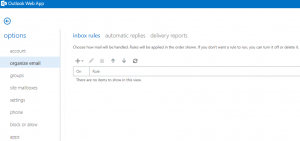
a. Click’ options

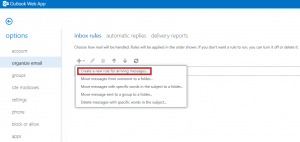
2. Go to “Organize email”
a. Click’ on plus sign

01


b. Select “create new rule for arriving messages…”

02


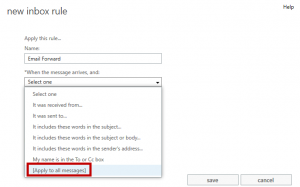
3.Create a name for your forward i.e. (Email Forward)

a. Click drop down menu under “when the messages arrives” Select “Apply to all messages”

03


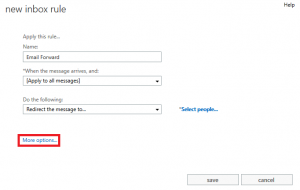
4. Then click “More Options”

05


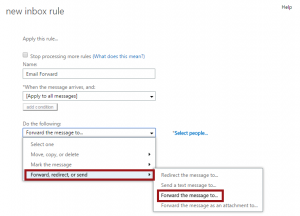
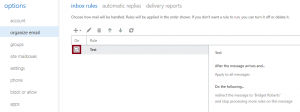
5. Click on drop down “do the following” the click “Forward, redirect, or send” than select “Forward message to”

06


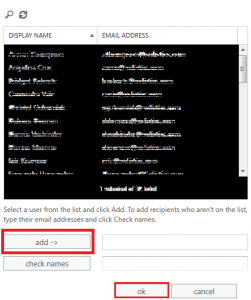
6. Then you will need to select the person you would like to forward your emails to. Click “add” then click “ok”

07


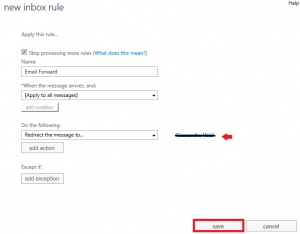
7. The name of the recipient will appear next to the red arrow, ensure it is correct then click “save”

08


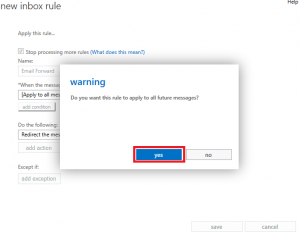
8. When you receive this the following warning click “yes”

09


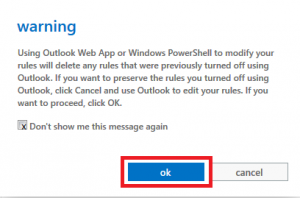
9. You will also receive this pop up message. Check the box and click “ok”

10


Once you have completed these steps the forward should take effect instantly. I would suggest testing the forward to ensure it was set up correctly. If you would like to disable the forward you will need to uncheck the box next to the forward as shown below.

disable forward

https://info.globalit.com/wp-content/uploads/2016/06/03.png|https://info.globalit.com/wp-content/uploads/2016/06/05.png|https://info.globalit.com/wp-content/uploads/2016/06/06.png|https://info.globalit.com/wp-content/uploads/2016/06/07.png|https://info.globalit.com/wp-content/uploads/2016/06/08.png|https://info.globalit.com/wp-content/uploads/2016/06/09.png|https://info.globalit.com/wp-content/uploads/2016/06/10.png|https://info.globalit.com/wp-content/uploads/2016/06/01.png|https://info.globalit.com/wp-content/uploads/2016/06/02.png|https://info.globalit.com/wp-content/uploads/2016/06/disable-forward.png

Case Studies

Online Content Thought Process

content

1. Is the content relevant?

When adding new content, one must be sure that it has a purpose and is not a random addition that will clutter the page. The addition must fall under the correct category for the page it is on. It must be appropriate for what is happening and the circumstances that surrounds this information.

2. Does this sound helpful or like a sales pitch?

It is important to look at the information being added from the clients’ perspective. This does not mean the content of the message must be changed, but how it is said must be looked at. If a consumer is reading the information they do not want to feel like they are constantly being sold something. A reader will stop reading if they do not understand what is being said. Because of this, content must be helpful and easy to understand so the client feels like their needs are being met.

3. Is this new information being beneficial?

The website already has a lot of content. This means when thinking about adding more content, one must think about if this new information is necessary. Does this new content make the website or page better? Is it necessary that this is being said and is it being said in a concise and effective way? These are things needing to be considered before adding more to the page.

4. Is this the best way to say it?

Wording is a very important factor in any content. The way a sentence is written can really make a difference. On a site like this the best thing to do is make the phrasing of a sentence effective with minimum words.

5. Is the content free of errors?

This is the most common mistake and the one most easily found. People who are really reading this site will find errors in the content and may find a mistake unprofessional and sloppy. In order to keep the content in the best form, content must be proofread by multiple people, multiple times before added to the site. This is the case for everything written and published.

6. Is this design mobile friendly?

With a world increasingly dependent on mobile devices, everything published online must be accessible by computer and smartphone. This is a factor looked at by consumers and by google. Commonly, a site is found by a quick search on a phone before continuing on a computer for further research into a company’s page. Being a technological company, it is imperative that all bases are covered in these ways.

https://info.globalit.com/wp-content/uploads/2016/06/content.png

How-To|Online Marketing|Web Design

Local small business promotion

Best-of-the-Best

Global IT Small Business (GSB) Promotions for local small business – Whittier Chamber of Commerce members

  • Option 1: GSB IT Mth/Mth maintenance package 1: Unlimited remote network, computer, service, support, and monitoring with security protection for 1-5 employees or less for $300.00/Mth – Cancel at any time.
  • Option 1B: 2 x hrs. On-site labor each month, Unlimited remote computer and network support, 1 x travel charge, 5 x PC’s Global eye business edition security suite, and remote management licensing, Monitoring with alerts on up to 5x PC’s, network and ISP $50.00
    • Total: $450.00/Mth
  • Option 2: GSB IT Mth/Mth maintenance package 2: Unlimited remote network, computer, service, support, and monitoring with security protection for 10 employees or less for $550.00/Mth – Cancel at any time.
  • Option 2B: 2 x hrs. On-site labor each month, Unlimited remote computer and network support, 1 x travel charge, 5-10 x PC’s Global eye business edition security suite, and Remote management licensing, Monitoring with alerts on up to 5-10 PC’s, network and ISP support
    • Total: $725.00/Mth/Mth

See the Global IT 100% satisfaction guarantee!

_BDP4448_Shaun_DC-v2

https://info.globalit.com/wp-content/uploads/2016/05/BDP4448_Shaun_DC-v2.jpg|https://info.globalit.com/wp-content/uploads/2016/05/Best-of-the-Best.png

Promotions

Cybersecurity, Encryption and Congress

cybersecurityWhat would you do if the government said that the contractor who built your home must have a spare set of keys to the home, and there must be a door built on your home that only the contractor could access? Would you feel safe? How would you feel knowing that law enforcement could secretly enter your home any time it wanted simply by serving a warrant on the contractor who built your home?

When you put security in general terms such as the ones above, it sounds silly to mandate that contractors have a key to every home they have built. But in the wake of the iPhone debacle between the F.B.I. and Apple, a new bill in being introduced in Congress is trying to force technology manufacturers to make sure that your data is available to law enforcement, and anyone else who can get a copy of the key to your smartphone’s front door.

This Did Not Start In San Bernardino, California

san_bernardino_shootingThe terrorist attacks in late 2015 in San Bernardino, California brought the issue of encryption to the forefront because of the very public battle between Apple and the F.B.I. According to the New York Times, government law authorities made 4,000 requests to access information on 16,000 phones in the second half of 2015. The reason the San Bernardino case became so popular is because the government deemed the incident an act of terrorism, and fighting terrorism is a prime concern in the United States.

Under normal circumstances, federal law mandates that technology companies provide information for investigations unless the company feels that providing that information would be harmful in some way. Apple argued that being asked to bypass its own encryption would weaken the security it offers its customers, and that sparked a battle that is still raging.

The Secure Data Act Versus The Compliance With Court Orders Act Of 2016

In 2015, long before any battles over encryption in the media, Senator Ron Wyden and Representative Zoe Lofgren introduced the Secure Data Act to Congress. In a nutshell, the Secure Data Act says that manufacturers cannot be told by any government agency to weaken the security of their products to allow investigators to access encrypted data. The bill is still in draft form in both houses, but it has gained a great deal of support since the battle between Apple and the F.B.I. over San Bernardino.

After the San Bernardino encryption battle was made public, Senators Dianne Feinstein and Richard Burr introduced the Compliance With Court Orders Act of 2016. This act basically says that manufacturers must create ways to bypass their own encryption, or have a method for storing user data so that it can be turned over to investigators. This is the legal version of the contractor with a key to your house example we started with. This bill is also in draft form, and it is causing a lot of controversy, but having problems gaining real traction.

The Core Of The Debate

privacy_lawsWhat this debate boils down to is that some factions in the government want to force manufacturers to make user data accessible, and other factions want to preserve privacy. If the Compliance With Court Orders Act is passed, companies like Google would have to redesign products such as Gmail to make user data accessible. Right now, Google cannot read user emails at all unless Google has access to a user’s computer. If this bill becomes law, Google and anyone else who can get past the weakened Gmail encryption could read any user’s email.



If the new compliance bill becomes law, then user data could be exposed at levels that the lawmakers may not realize. A disgruntled Google employee could wind up selling data from millions of Gmail address, or a terrorist could access an iPhone to get all of the personal data that phone contains. As it stands right now, it is almost impossible for tech companies to access encrypted data, and that is what makes the data so safe. If things start to change, then there could be major issues with privacy that users may not realize until it is too late.

https://info.globalit.com/wp-content/uploads/2016/05/download.jpg|https://info.globalit.com/wp-content/uploads/2016/05/12.-online-threat.jpg|https://info.globalit.com/wp-content/uploads/2016/05/Cyber-Security-2.jpg|https://info.globalit.com/wp-content/uploads/2016/05/cybersecurity.jpg

Case Studies

Madison Valleywood – Taking Down ISIS with Technology

Madison Valleywood sounds like a character from the next John Waters’ film, but it is actually a nickname given to the United States government’s latest attempt to combat ISIS online. Despite what may be the popular conceptions up to this point, ISIS is not reaching out and causing havoc at high levels through cyber terrorism. In order to understand what is and can be done to defeat ISIS online, it is important to have a general understanding of ISIS and how it works.

isis_online_terrorists

What Is ISIS?

ISIS is a terrorist organization that occupies large portions of Syria and Iraq, and has declared its intentions to create an Islamic world which ISIS would rule. As of 2016, ISIS has about eight million civilian subjects and several sources of income to fuel its efforts. Some of the more lucrative recurring sources of ISIS income include:

  • Income tax on its people
  • Oil revenue of around $1 million to $3 million per day
  • Money stolen from the banks and governments ISIS defeats

The primary stated goal of ISIS is to bring down the Western World and replace it with Islamic rule, ISIS style. ISIS is smart enough to know that if it wants to defeat the Western World, it will have to become proficient in cyber terrorism. When you take an objective look at what ISIS has been able to accomplish so far online, the future does not look bright for this terrorist organization.

The ISIS Online Threat

It is important for people to remember that just because ISIS takes credit for a major online security breach does not necessarily mean that ISIS actually committed the breach. Despite the availability of money and recruits with technical backgrounds, ISIS’ Internet capabilities are extremely limited. To this point, ISIS has only been able to:

  • Use social media to recruit new members and send out threatening messages to the Western World
  • Hack websites with weak security protocols
  • Take advantage of lapses in online security for larger websites and exploit those weaknesses

Right now, the online capabilities of ISIS rival those of a group of hackers angry at the world. While ISIS has been able to hack into low level government websites and some American banks, its ability to hack credit card user databases is commonplace among other high level hacker groups.

ISIS_Online

Where ISIS really shines online is its use of social media to recruit new members, arrange attacks using lone attackers, transfer funds to groups around the world, and send video messages to the world. As long as ISIS is able to reach mass audiences using social media, then it remains a threat.

What The Government Is Doing

Madison Valleywood is the nickname given to the government initiative to reach out to technology companies and social media websites to shut down the access ISIS has to the rest of the world. Companies such as Apple, Facebook, and Twitter are being asked to develop ways to combat ISIS online, and also being asked to follow government directives to remove the ability for ISIS to use the Internet in its operations.

n shows that there are still some areas where technology companies are unwilling to alter what they do to appease the government. However, Twitter has shut down hundreds of thousands of ISIS-related accounts and is constantly gathering data to shut down more accounts. If Madison Valleywood becomes a cohesive operation between the government and the companies of Silicon Valley, then that may be all of the technology the government will need to help defeat ISIS once and for all.

Find out more:

http://www.defenseone.com/technology/2016/01/americas-new-plan-fight-isis-online/125043/

https://www.flashpoint-intel.com/home/assets/Media/Flashpoint_HackingForISIS_April2016.pdf

http://blogs.berkeley.edu/2015/03/02/how-to-defeat-isis-and-why-it-probably-wont-happen/

http://www.cnn.com/2016/02/24/politics/justice-department-apple-fbi-isis-san-bernardino/

https://info.globalit.com/wp-content/uploads/2016/05/ISIS_TRAIL_OF_TERROR_16x9_992.jpg|https://info.globalit.com/wp-content/uploads/2016/05/external.jpg

Case Studies

Want Free Anti-virus Protection?

May Promo

Try our computer security software during the month of May to get free installation, free scanning one month free, and all Global IT products come with a 90-day 100% satisfaction guarantee.

Receive full internet browsing, malware, adware, spyware, firewall, and anti-virus protection at $3.50 per month,  protect all your computer systems, from the staff at the office to your kids at home.

Features include:

  • Proactive monitoring; partially or all systems, networks, resources, and devices
  • Operating 24 hours a day, 7 days a week, 365 days of the year
  • Live Grid, provides real-time proactive protection, detecting threats before they enter your system
  • High malware detection
  • Firewall
  • Browser protection
  • Light Footprint
  • Attachment or program inspection
  • Pattern signatures
  • Behavior monitoring
  • Blacklist lookup
  • High performance
  • Management administration console maintained by Global IT

Need further assistance? Talk to a computer security specialist!

Need_help_Contact_us

https://info.globalit.com/wp-content/uploads/2016/05/May-Promo.jpg

Case Studies